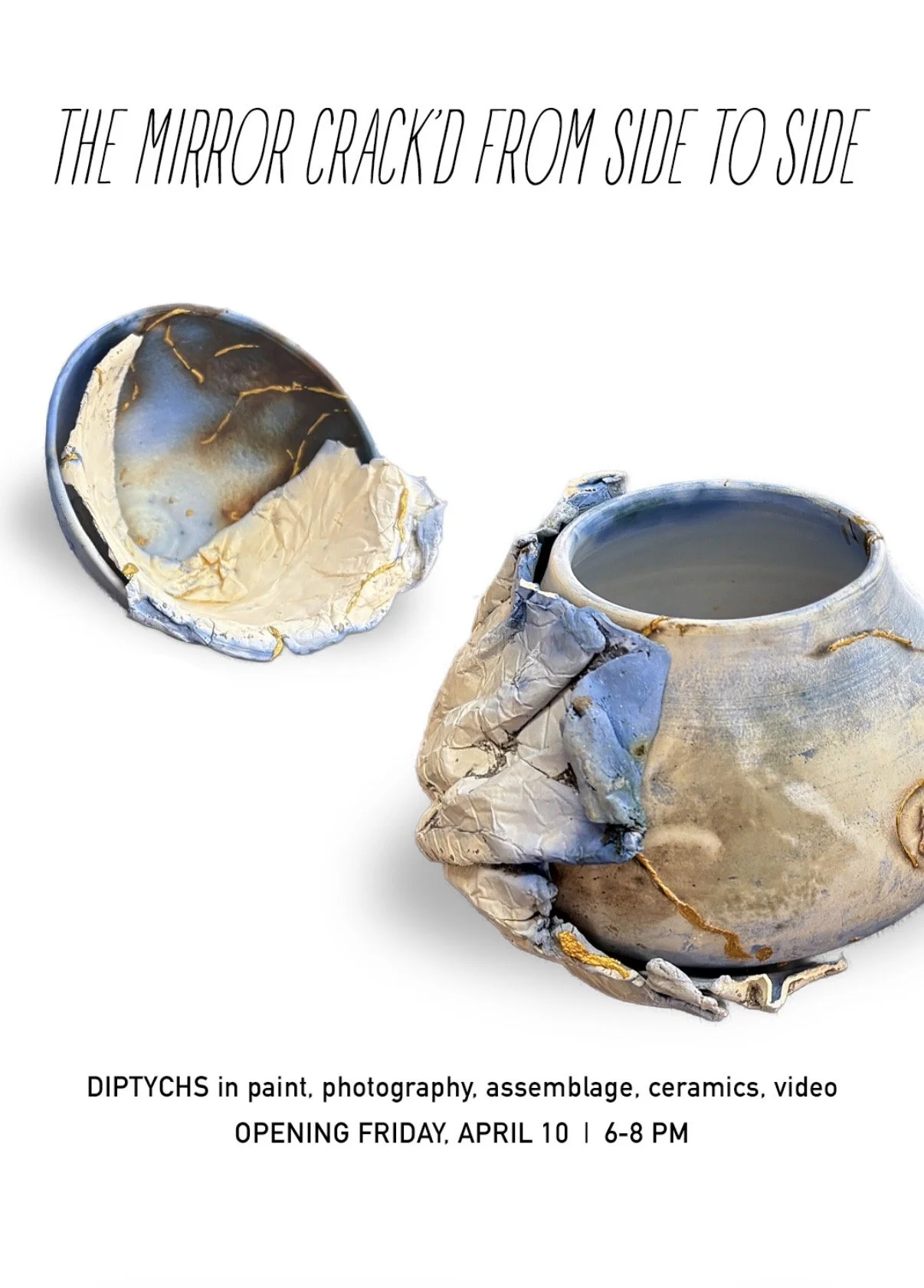
Gagné Contemporary is pleased to present The Mirror Crack’d from Side to Side, a show of diptychs in paint, photography, assemblage, ceramics and video. Please join us for the Opening on Friday, April 10 from 6-8pm.
The show features artists Alison Brannen, Lori Coulter, Nick Fox-Gieg, Bill Greaves, Horst Herget, Cate McGuire, Erik Mohr, Ella Morton, Stan Olthuis, Howard Podeswa, Jobelle Quijano, and Meagan Williams.
In Alfred, Lord Tennyson’s poem The Lady of Shalott, the shattering of a mirror marks the exact moment a solitary, reflected existence collides with the chaos of the real world. To look directly is to break the frame. The Mirror Crack’d from Side to Side takes this rupture as a starting point, exploring the diptych as an artistic practice defined by the break in our field of vision.
Assemblage and sculpture wear diptychs well. Lori Coulter’s “The Secret Life of Women” is a devotional work comprised of domestic linen, vintage buttons, bones, stitching and corsages arranged in two shadow boxes summoning her female ancestors. Stan Olthuiswinds us up by colliding bicycle tire tubes against tightly coiled steel springs in “Devotion”. And Nick Fox-Gieg brings his work “An Iconoclast 002” running double screen high-definition videos of repetitive motion against chaotic motion.
Ella Morton and Meagan Williams both bring experimental darkroom techniques to their photography to rupture and stress their images. Morton’s “Iceberg, Spillars Cove #1”, shot in Bonavista, Newfoundland, is the result of a wet plate collodion process, printed on glass (ambrotype) and then shattered. The gold line repair, a Kintsugi practice, speaks to the fragility of all things – icebergs, landscapes, and certainly ourselves. Williams’ destructive analog techniques finds her shooting expired film and exposing the roll to a chemical soup in the darkroom, as seen with “Mount Rundle/Policeman’s Creek”. Horst Herget also utilizes alternative methods for his photography – in “Elegy” he combines separate printed glass elements to conjure one fluid image that floats on the viewer’s roving eyeline. Cate McGuire manipulates published magazine photography into severe collages in diptych form, as evidenced by “Hide In Plain Site” – rearranging surfaces and space in strange new ways.
Alison Brannen’s sculptural vessels, “Cockle Shell Aryballos”, are sagger-fired ceramics with Kintsugi repair. Recently created on the island of Skopolos, they’re inspired by the ritual aryballos of ancient Greece, delicate vessels for perfumed body oils. Bill Grieves is hanging “Fragments of An Unsettled System” – this diptych shares traces of a structure that has been interrupted. Surfaces are developed with layers of slip and glaze, partially removed then reintroduced. Crackle and variation emerge through firing.
Howard Podeswa’s work, “Verso 1 Verso 2”, originated with his current project, painting the backs of his father’s canvases. The artist has noted that “the backside of the painting is not made to be seen, yet it holds its own portrait.” The conceptual restraint and the muscular treatment of the paint unify the two. Jobelle Quijano’s diptych of “Scene Queen/Magical Girl”, in her characteristic palette, has a knowing innocence that permeates both polarities of her painting. Erik Mohr lands a one-two punch with “Rubber Glove/Tattoos” – borne out of Covid-era isolation, highly detailed oil paintings on found wooden furniture boards present two possibilities in the face of viral dread – don’t touch me vs forget it! give me a hug.